
Understanding the Regulatory Difference That Makes Advanced Regenerative Medicine Possible
If you’ve researched stem cell therapy for chronic pain, degenerative conditions, or sports injuries, you’ve likely encountered a frustrating reality: many of the most promising regenerative treatments aren’t readily available in the United States, but they are in Mexico.
This isn’t because Mexican medical care is less safe or regulated. In fact, Mexico has rigorous medical oversight through COFEPRIS (Comisión Federal para la Protección contra Riesgos Sanitarios)—the Mexican equivalent of the FDA. The difference lies in how these two regulatory agencies approach emerging medical treatments, particularly regenerative medicine and stem cell therapy.
At RejuvStem in Cancun, Mexico, we operate under strict COFEPRIS oversight, providing advanced stem cell treatments that meet or exceed international safety standards while offering therapeutic options not yet widely approved in the United States. Understanding the regulatory landscape helps you make informed decisions about your healthcare options.
What is COFEPRIS?
COFEPRIS (Federal Commission for the Protection against Sanitary Risks) is Mexico’s primary health regulatory authority, established in 2001 as part of Mexico’s Ministry of Health. According to the World Health Organization, COFEPRIS is recognized as one of the most advanced regulatory agencies in Latin America.
COFEPRIS Responsibilities
COFEPRIS regulates:
- •Pharmaceuticals and biologics (including stem cell products)
- •Medical devices and equipment
- •Healthcare facilities and hospitals
- •Clinical trials and research
- •Import and export of medical products
- •Advertising of health products and services
- •Food safety and supplements
- •Environmental health risks
COFEPRIS International Recognition
COFEPRIS maintains cooperative agreements with:
- •FDA (United States) – Information sharing and collaboration
- •EMA (European Medicines Agency) – Regulatory harmonization
- •Health Canada – Joint initiatives
- •Pan American Health Organization (PAHO) – Regional health security
- •WHO (World Health Organization) – International standards compliance
This international cooperation ensures Mexican healthcare meets global safety standards.
What is the FDA?
The Food and Drug Administration (FDA) is the United States’ federal agency responsible for protecting public health by regulating food, drugs, medical devices, and biological products. Established in 1906, the FDA is one of the world’s oldest and most influential health regulatory agencies.
FDA Responsibilities
The FDA regulates:
- •Prescription and over-the-counter drugs
- •Biological products (including stem cells)
- •Medical devices
- •Food safety
- •Cosmetics
- •Tobacco products
- •Veterinary products
FDA’s Regulatory Authority
According to the FDA’s official website, the agency:
- •Approves new drugs and medical treatments through rigorous clinical trials
- •Monitors safety of approved products
- •Enforces compliance with federal regulations
- •Investigates potential violations
- •Issues warning letters and takes enforcement actions
- •Protects consumers from unsafe or fraudulent products
The FDA’s authority is comprehensive and its standards are considered among the strictest in the world.
COFEPRIS vs. FDA: Key Regulatory Differences
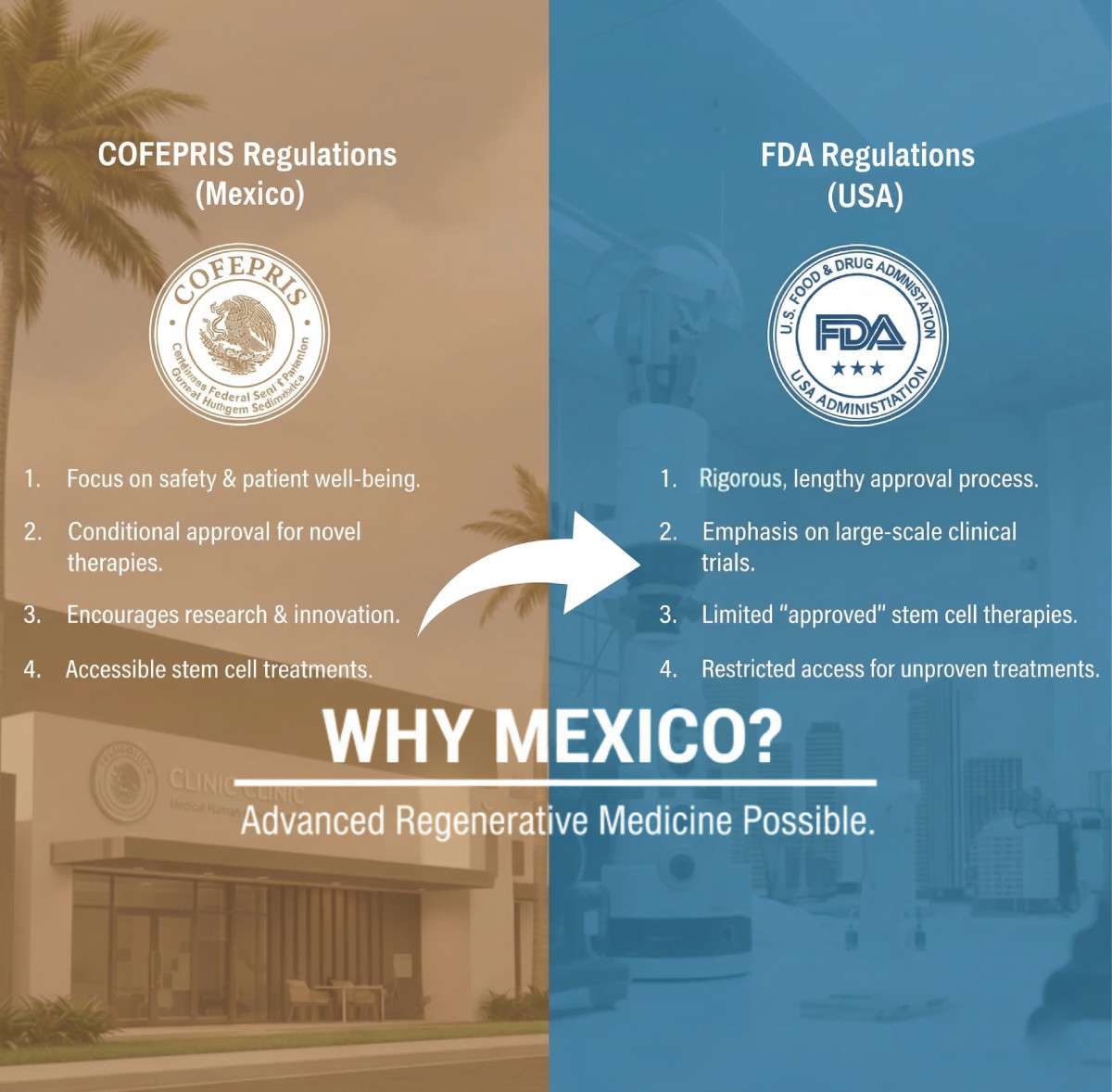
Both agencies prioritize patient safety, but they approach emerging medical treatments—particularly stem cell therapy—very differently.
Regulatory Philosophy
FDA Approach: Highly Conservative, Extensive Pre-Approval Required
The FDA requires extensive clinical trials before approving new treatments:
- •Phase I trials – Safety testing (20-100 participants, 1-2 years)
- •Phase II trials – Efficacy and dosing (100-300 participants, 2-3 years)
- •Phase III trials – Large-scale confirmation (1,000-3,000 participants, 3-4 years)
- •FDA Review – Comprehensive evaluation (1-2 years)
- •Total timeline – Often 10-15+ years from discovery to approval
Advantages:
- •Extremely thorough safety and efficacy data
- •Very low risk of approved treatments causing harm
- •Comprehensive understanding of long-term effects
Disadvantages:
- •Many promising treatments unavailable for years or decades
- •Patients with serious conditions can’t access potentially life-changing therapies
- •Enormous costs ($1-2 billion average to bring drug to market) passed to patients
- •Innovation stifled by lengthy approval process
COFEPRIS Approach: Risk-Based, Adaptive Regulation
COFEPRIS takes a more flexible, evidence-based approach:
- •Evaluates safety and efficacy on continuum
- •Allows certain therapies based on preliminary evidence when benefit-risk ratio favorable
- •Requires ongoing safety monitoring and reporting
- •Can approve treatments conditionally with continued evidence gathering
- •Adapts regulations as new evidence emerges
Advantages:
- •Patients can access promising therapies years or decades earlier
- •Treats patients as informed decision-makers
- •Promotes medical innovation
- •Reduces treatment costs (less regulatory burden)
Disadvantages:
- •Slightly higher theoretical risk (though actual safety record excellent)
- •Less long-term data at time of approval for some treatments
- •Requires patients to do more research and due diligence
Stem Cell Therapy Regulation: The Critical Difference
This is where COFEPRIS and FDA diverge most significantly, and why thousands of Americans travel to Mexico for stem cell treatment.
FDA’s Strict Limitations on Stem Cell Therapy
According to FDA guidance on stem cells, the FDA severely restricts stem cell use:
What’s Allowed in the U.S.:
- •Autologous stem cells (from patient’s own body) that are: minimally manipulated; used for homologous purpose (same function); administered during single surgical procedure
What’s NOT Allowed (Without FDA Approval):
- •Allogeneic stem cells (from donor sources like umbilical cord)
- •Stem cells that are “more than minimally manipulated”
- •Cultured or expanded stem cells
- •Stem cells combined with other substances
- •Stem cells used for non-homologous purposes
Result: Most advanced stem cell therapies Americans need are unavailable in the U.S. or only available through extremely expensive clinical trials.
COFEPRIS’s Evidence-Based Stem Cell Framework
COFEPRIS regulates stem cell therapy based on scientific evidence and safety data:
What’s Allowed in Mexico:
- •Umbilical cord-derived mesenchymal stem cells (allogeneic)
- •Properly processed and quality-controlled cell products
- •Higher concentrations of stem cells
- •Combination therapies when scientifically supported
- •Treatment of conditions with strong evidence base
Requirements:
- •Rigorous cell processing standards
- •Quality control and sterility testing
- •Physician training and certification
- •Patient consent and education
- •Adverse event reporting
- •Ongoing safety monitoring
Result: Patients can access advanced regenerative treatments backed by scientific evidence while maintaining safety oversight.
Manufacturing and Quality Control Standards
Both COFEPRIS and FDA require:
- •cGMP (current Good Manufacturing Practice) compliance
- •Sterility testing and quality assurance
- •Traceability and documentation
- •Regular facility inspections
- •Adverse event monitoring and reporting
Key Difference:
- •FDA requires additional IND (Investigational New Drug) applications for most stem cell therapies
- •COFEPRIS allows properly manufactured stem cell products without IND when safety established
Clinical Evidence Standards
FDA Approach:
- •Requires randomized, double-blind, placebo-controlled trials for approval
- •Demands extensive Phase III data showing statistically significant benefits
- •Conservative interpretation of safety data
- •Very high bar for approval
COFEPRIS Approach:
- •Evaluates totality of evidence including: published clinical studies (including international research); case series and retrospective data; real-world evidence from clinical practice; international regulatory approvals; risk-benefit analysis for specific conditions
- •More pragmatic approach balancing safety with patient access
Enforcement and Oversight
FDA Enforcement:
- •Issues warning letters to clinics making unapproved claims
- •Conducts raids and shutdowns of non-compliant facilities
- •Pursues legal action including injunctions and seizures
- •Very aggressive enforcement against unapproved stem cell clinics
- •Has shut down hundreds of U.S. stem cell clinics since 2017
COFEPRIS Enforcement:
- •Licenses and inspects healthcare facilities
- •Monitors compliance with quality standards
- •Investigates complaints and adverse events
- •Can suspend or revoke licenses for violations
- •Focuses on patient safety while allowing evidence-based innovation
Why Advanced Stem Cell Therapy is Available in Mexico
The regulatory difference creates a practical reality: Mexico offers legal access to advanced stem cell therapies that Americans desperately need but cannot obtain at home.
Conditions Treatable with Stem Cells in Mexico (But Limited/Unavailable in U.S.)
Orthopedic and Musculoskeletal:
- •Degenerative disc disease (lumbar and cervical)
- •Herniated and bulging discs
- •Facet joint syndrome
- •Osteoarthritis (knee, hip, shoulder, spine)
- •Meniscus tears
- •Rotator cuff tears
- •Chronic tendinopathies (Achilles, patellar, rotator cuff)
- •Ligament injuries (ACL, MCL, ankle)
- •Sports injuries
- •Rheumatoid arthritis
- •Multiple sclerosis
- •Lupus
- •Crohn’s disease and ulcerative colitis
- •Psoriasis and psoriatic arthritis
- •Stroke recovery
- •Traumatic brain injury
- •Spinal cord injury
- •Peripheral neuropathy
- •Parkinson’s disease
Metabolic and Systemic:
- •Type 2 diabetes
- •Chronic kidney disease
- •Liver disease (cirrhosis, NASH)
- •COPD
Why U.S. Patients Choose Mexican Stem Cell Therapy
According to industry estimates, 30,000-50,000 Americans travel to Mexico annually for stem cell therapy. Here’s why:
Access to Advanced Treatments:
- •Umbilical cord mesenchymal stem cells (not available in U.S.)
- •Higher cell concentrations (20-100 million cells vs. limited amounts in U.S.)
- •Multiple injection sites treated in one session
- •Combination protocols optimized for specific conditions
Significant Cost Savings:
- •U.S. stem cell therapy (where available): $5,000-$25,000+ per treatment site
- •Mexico stem cell therapy: $3,500-$10,000 for comprehensive treatment
- •Savings of 50-80% compared to limited U.S. options
No Insurance Restrictions:
- •Most U.S. insurers don’t cover stem cell therapy
- •High deductibles and out-of-pocket maximums
- •Prior authorization denials common
- •Mexico offers transparent, affordable self-pay pricing
Faster Access:
- •No waiting for FDA approval that may never come
- •No enrollment in restrictive clinical trials
- •Treatment available within weeks of consultation
Quality Care:
- •Board-certified physicians trained in regenerative medicine
- •Modern facilities with international accreditation
- •Same safety standards as U.S. hospitals
- •English-speaking medical staff
Safety Considerations: COFEPRIS-Regulated Stem Cell Therapy
A common concern: “Is stem cell therapy in Mexico safe?”
The answer: Yes, when performed at properly licensed, COFEPRIS-regulated facilities like RejuvStem.
COFEPRIS Safety Requirements for Stem Cell Clinics
Licensed facilities must meet strict standards:
Facility Requirements:
- •Proper medical licensing and registration
- •Sterile processing environments
- •Quality-controlled stem cell processing laboratories
- •Regular COFEPRIS inspections
- •Documented standard operating procedures
- •Staff training and certification
Cell Product Requirements:
- •Stem cells from verified, ethical sources
- •Microbiological testing (sterility, endotoxin, mycoplasma)
- •Viability testing (minimum 85% viable cells)
- •Cell count verification
- •Fresh, never-frozen cell handling
- •Complete traceability and documentation
Clinical Requirements:
- •Physician evaluation and medical necessity determination
- •Informed consent with risks and benefits
- •Proper injection technique with imaging guidance
- •Post-treatment monitoring
- •Adverse event reporting to COFEPRIS
- •Patient follow-up and outcomes tracking
How to Identify Safe, Legitimate Stem Cell Clinics in Mexico
Green Flags (Safe, Quality Providers):
- •COFEPRIS licensed and registered
- •Board-certified physicians specializing in regenerative medicine
- •Transparent about cell source, processing, and concentrations
- •Provides detailed informed consent
- •Uses ultrasound or fluoroscopic guidance for injections
- •Publishes patient outcomes and testimonials
- •Offers free consultations with thorough medical evaluation
- •Doesn’t make unrealistic promises or guarantees
- •Provides detailed post-treatment protocols
- •Available for follow-up and questions
Red Flags (Avoid These Providers):
- •No verifiable COFEPRIS licensing
- •Vague or secretive about cell source and processing
- •Makes miracle cure claims or guarantees
- •Treats every condition with same protocol
- •Pressures for immediate payment
- •Offers extremely low prices (significantly below market)
- •No physician evaluation or medical records review
- •Poor English communication or unprofessional website
- •No follow-up or post-treatment support
- •Negative reviews or regulatory warnings
RejuvStem’s COFEPRIS Compliance and Safety Standards
At RejuvStem, we exceed COFEPRIS requirements:
Our Regulatory Compliance:
- •Fully licensed by COFEPRIS
- •Regular facility inspections and compliance audits
- •All physicians board-certified in relevant specialties
- •Comprehensive adverse event monitoring and reporting
Our Cell Quality:
- •Fresh (never frozen) cells from ethically sourced tissue (donated after healthy births)
- •Processed in cGMP-compliant laboratories
- •Every batch tested for sterility, viability, potency
- •20-100 million viable cells per treatment (concentration based on condition)
- •Complete documentation and traceability
Our Clinical Excellence:
- •Thorough pre-treatment evaluation (medical history, imaging review, physical examination)
- •Image-guided injections (ultrasound or fluoroscopy) for precision
- •Condition-specific protocols based on scientific evidence
- •Comprehensive post-treatment rehabilitation guidance
- •24/7 availability for questions and concerns
- •Long-term follow-up and outcomes tracking
Our Transparency:
- •Clear explanation of treatment, risks, and expected outcomes
- •Published success rates and patient testimonials
- •Honest assessment of candidacy (we turn away patients who won’t benefit)
- •Transparent pricing with no hidden fees
The Future of Stem Cell Regulation
The regulatory landscape for stem cell therapy continues evolving in both countries.
FDA Movement Toward Expanded Access
Recent developments suggest potential FDA evolution:
Regenerative Medicine Advanced Therapy (RMAT) Designation:
- •Expedited development and review for promising regenerative therapies
- •Closer FDA collaboration with developers
- •Potential for accelerated approval
Right to Try Laws:
- •Allows terminally ill patients to access experimental treatments
- •Bypasses some FDA requirements
- •Limited application but establishes precedent for patient choice
Ongoing Clinical Trials:
- •Hundreds of stem cell trials ongoing in U.S.
- •Some may lead to FDA approvals in coming years
- •But timeline still 5-15+ years for most applications
COFEPRIS Commitment to Evidence-Based Innovation
Mexico continues refining its regenerative medicine framework:
Enhanced Quality Standards:
- •Stricter facility and laboratory requirements
- •Improved physician training and certification
- •Better adverse event monitoring systems
Evidence Generation:
- •Encouraging outcomes research and publication
- •Collaboration with international researchers
- •Registry development for long-term safety data
International Harmonization:
- •Aligning with global best practices
- •Maintaining cooperation with FDA, EMA, others
- •Participating in international regulatory discussions
The Medical Tourism Reality
Regardless of regulatory evolution, medical tourism for stem cell therapy will continue because:
- 1.FDA approval timeline too slow for patients suffering now
- 2.Cost differential remains massive even if more treatments approved
- 3.Mexico offers proven safety and quality under COFEPRIS oversight
- 4.Patient testimonials and outcomes demonstrate real benefits
- 5.Geographic proximity makes Mexico accessible to Americans
Making an Informed Decision About Stem Cell Therapy in Mexico
Understanding COFEPRIS vs. FDA regulations empowers you to make informed healthcare decisions.
Questions to Ask Before Traveling to Mexico
About the Facility:
- 1.Are you licensed and registered with COFEPRIS?
- 2.Can I verify your license and credentials?
- 3.How long have you been providing stem cell therapy?
- 4.How many patients have you treated for my condition?
- 5.What are your success rates and outcomes?
About the Treatment:
- •6. What type of stem cells will be used? (Umbilical cord MSCs are gold standard)
- •7. Where do the stem cells come from and how are they processed?
- •8. What concentration of cells will I receive?
- •9. How many injection sites will be treated?
- •10. Will imaging guidance be used for precision?
About Safety and Quality:
- •11. How are stem cells tested for safety, sterility, and quality?
- •12. What adverse events have you observed, and how often?
- •13. How will you monitor me during and after treatment?
- •14. What follow-up and support do you provide?
About Expected Outcomes:
- •15. What results can I realistically expect?
- •16. What’s the timeline for improvement?
- •17. Will I need additional treatments?
- •18. What happens if the treatment doesn’t work?
About Costs:
- •19. What’s the total cost, and what’s included?
- •20. Are there any additional fees?
- •21. Do you offer financing or payment plans?
- •22. What’s your refund or guarantee policy?
Red Flags That Should Make You Walk Away
- •Refusal to answer questions or provide documentation
- •Inability to verify COFEPRIS licensing
- •Guarantees of cure or specific outcomes
- •Pressure tactics or limited-time offers
- •Extremely low prices or hidden fees
- •Treatment of every condition with identical protocol
- •No physician evaluation or medical review
- •Poor communication or unprofessional conduct
Why Thousands Choose RejuvStem
COFEPRIS-Compliant Excellence: We operate under full COFEPRIS oversight with rigorous safety protocols, giving you confidence in the quality and legality of your treatment.
Transparent, Evidence-Based Medicine: We explain exactly what we’re doing, why we’re doing it, and what you can realistically expect based on scientific evidence and our clinical experience.
Accessible, Affordable Care: We provide the advanced stem cell therapy you need at a fraction of U.S. costs, without compromising quality or safety.
Comprehensive Patient Support: From initial consultation through long-term follow-up, we’re with you every step of your healing journey.
Understanding Your Options: The Regulatory Reality
The COFEPRIS vs. FDA regulatory difference isn’t about one agency being “better” than the other—it’s about different philosophies balancing safety and access.
The FDA prioritizes absolute certainty through extensive trials, even if that means patients wait years or decades for treatments.
COFEPRIS prioritizes evidence-based access, allowing patients to choose promising therapies with appropriate safety oversight.
For Americans suffering from chronic pain, degenerative conditions, or sports injuries, this regulatory difference means:
- •Access to advanced umbilical cord stem cell therapy
- •Treatment available now, not in 10-15 years
- •Rigorous safety standards under COFEPRIS oversight
- •Significant cost savings compared to limited U.S. options
- •Quality care from board-certified physicians
- •Real results for conditions conventional medicine can’t adequately treat
You don’t have to choose between safety and access. At RejuvStem, you get both.
Take Control of Your Healthcare Journey
If you’re suffering from chronic pain, degenerative joint disease, sports injuries, or other musculoskeletal conditions, you have options beyond what’s available in the United States.
COFEPRIS-regulated stem cell therapy in Mexico offers:
- •Legal, safe access to advanced regenerative treatments
- •Quality care meeting international standards
- •Significant cost savings
- •Faster access without years of waiting
- •Real hope for healing conditions conventional medicine can’t adequately treat
Schedule your free consultation with RejuvStem today. We’ll review your medical history, explain our COFEPRIS-compliant treatment protocols, and determine if stem cell therapy can help you achieve the healing you deserve.
Don’t let regulatory limitations in the U.S. prevent you from accessing safe, effective treatment available just across the border.
Frequently Asked Questions
Is stem cell therapy in Mexico legal?
Is COFEPRIS as strict as the FDA?
How do I verify a clinic is COFEPRIS-licensed?
What type of stem cells are used in Mexico?
Are the stem cells safe?
Why can’t I get this treatment in the United States?
Will my insurance cover stem cell therapy in Mexico?
Is traveling to Mexico for medical care safe?
How do I choose a safe stem cell clinic in Mexico?
What conditions can be treated with stem cell therapy in Mexico?
Ready to explore your options for advanced stem cell therapy under COFEPRIS oversight?
Contact RejuvStem today for your free consultation:
- •+1 (302) 551 3530
- •info@rejuvstem.com
- •Port Marina Bonampak, Puerto Cancún, 77500 Cancún, Q.R., Mexico
- •SCHEDULE A FREE DISCOVERY CALL
RejuvStem – COFEPRIS-Licensed Stem Cell Therapy in Cancun
Safe, Legal, Advanced Regenerative Medicine