Why Families Are Asking
Every family’s experience with autism is different. Some children thrive with therapy, school support and time. Others face challenges with communication, sleep, attention or sensory overload that make daily life hard for the whole household.
It’s natural for parents to look at every option. Two that come up more and more are regenerative cell therapy and photobiomodulation, a gentle light-based therapy. At RejuvStem, we offer Dezawa MuseCells® and FireFly™ light therapy, and families often ask us whether either could help.
This article gives you an honest look at what these therapies are, what the research shows so far and what it doesn’t. Our goal is to help you ask the right questions, not to promise a cure. Autism is a lifelong neurodevelopmental difference, and no therapy changes who your child is.
The Research Behind the Interest
Autism has many causes, and genetics plays a major role. But researchers have also found that some autistic people show signs of neuroinflammation, meaning activated immune cells in the brain, along with differences in immune signaling and in how brain cells produce energy.
That research has led scientists to ask two questions:
- •Could calming inflammation and supporting the immune system help some children? This is the idea behind cell therapy research in autism.
- •Could supporting how brain cells produce energy and communicate help? This is the idea behind photobiomodulation research.
Neither question has a final answer yet. Here’s where each therapy stands.
Dezawa MuseCells® Cells
What They Are
First identified by Professor Mari Dezawa at Tohoku University in Japan, MUSE cells are a small, specialized population of the body’s own repair cells. Making up only about 1–5% of mesenchymal stem cells, they have several qualities that set them apart:
- •They seek out injury. MUSE cells follow distress signals released by damaged tissue (the S1P–S1PR2 pathway).
- •They can become many cell types, including neural-type cells, which is why researchers are studying them in brain conditions.
- •They calm the immune response. MUSE cells release factors that help regulate inflammation.
- •No donor matching is needed. About 200 patients in clinical studies have received donor MUSE cells by IV without HLA matching.
MUSE cells have been studied in human trials for stroke, heart attack, spinal cord injury, ALS, epidermolysis bullosa and newborn brain injury from lack of oxygen.
Where Autism Research Stands
To be clear: there are no published clinical trials of MUSE cells in autism. Today, MUSE cells appear in autism-related research mainly in the lab, where scientists turn them into nerve cells to study how neurodevelopmental conditions work.
The closest human evidence comes from other cell types. In 2020, Duke University published a trial in 180 children aged 2 to 7 who received umbilical cord blood or placebo. Overall, the trial did not find a significant improvement in social communication. A subgroup of children without intellectual disability showed some gains, which the researchers called a lead for future study. Duke has since moved on to research with cord tissue–derived mesenchymal cells.
What this means for families: the reason for interest in MUSE cells is their anti-inflammatory and nerve-supporting properties. Whether those properties translate into meaningful benefits for autistic children has not yet been tested in a clinical trial.
FireFly™ Photobiomodulation
What It Is
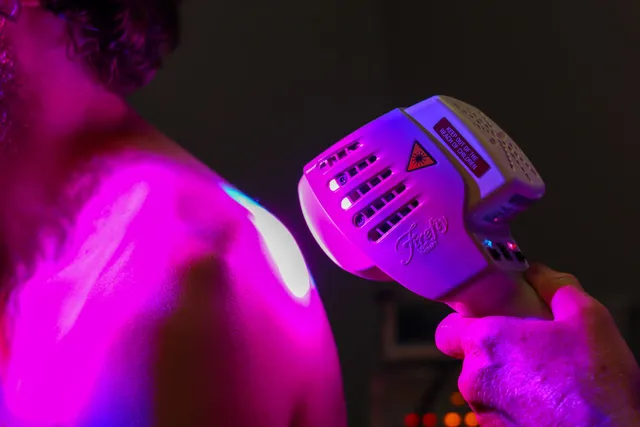
Photobiomodulation (PBM) uses specific wavelengths of red and near-infrared light to support how cells produce energy. The light is absorbed by mitochondria, the cell’s power plants, and can help reduce inflammation and oxidative stress. It’s painless, non-invasive and doesn’t involve heat damage or radiation.
FireFly™ is RejuvStem’s multi-spectrum LED light therapy system. It’s used for pain, inflammation and soft tissue healing, and to support neurological wellness.
Where Autism Research Stands
PBM has some of the most encouraging early data of any non-drug approach in autism, though the studies are still small.
A 2024 randomized, double-blind, sham-controlled trial in Frontiers in Neurology studied 30 children aged 2 to 6 with autism:
| Measure | Active light | Sham (placebo) |
|---|---|---|
| Children | 16 | 14 |
| Average drop in CARS score* | 9.9 points | 2.6 points |
| Children improving by 4.5+ points | 87% | 35% |
*CARS (Childhood Autism Rating Scale) measures autism-related traits; a lower score means fewer challenges.
The children received near-infrared light (850 nm) to the head twice a week for 8 weeks. No moderate or serious side effects were reported. Some had brief, mild effects such as overexcitement, headaches or more tics, which resolved quickly.
The authors called PBM potentially “safe and effective” but stressed the need for larger studies. The trial was small, the children were also receiving other therapies, and there was no long-term follow-up. It also used a dedicated transcranial device, so the results can’t be assumed to apply to every light therapy system.
Source: Frontiers in Neurology, 2024
How RejuvStem Approaches a Family’s Questions
We believe families deserve straight answers. When a parent contacts us about autism, here’s what to expect:
- 1.A conversation first. Our Patient Care team listens to your child’s history, current therapies and what you hope to see change.
- 2.A physician consultation. A RejuvStem physician reviews medical records and decides whether any therapy is appropriate. Sometimes the honest answer is no.
- 3.Clear expectations. We explain what the research shows, what it doesn’t and what realistic goals look like for your child.
- 4.Support, not replacement. Any therapy we offer works alongside your child’s existing care, such as speech, occupational and behavioral therapy and their pediatric and developmental specialists. It never replaces that care.
- 5.Coordination with your team. We encourage families to involve their child’s own doctors in every decision.
Questions Families Ask
Can stem cells cure autism?
No. No therapy cures autism, and any clinic that promises a cure should be a red flag. The research question is whether certain therapies might ease specific challenges for some children.
Is photobiomodulation safe for children?
In the 2024 trial, children aged 2 to 6 had no moderate or serious side effects, only brief, mild ones. Larger studies are still needed.
Are MUSE cells and photobiomodulation used together?
They work in different ways, and some families ask about both. Whether, and how, to combine any therapies is a decision for a physician after a full consultation.
What should I ask any clinic?
Ask what studies support the treatment for autism specifically, who makes the medical decisions, what the risks are, what results they track, and how they’ll work with your child’s current care team.
The Bottom Line
Dezawa MuseCells® and photobiomodulation are two of the most interesting areas in regenerative science. For autism, PBM has promising early trial results, and MUSE cells remain at the research stage. Families deserve both hope and honesty, and that’s what we aim to give.
Have questions? Book a consultation with the RejuvStem Patient Care team in Cancún to talk through your child’s situation with a physician.
This article is for informational purposes only and is not medical advice. Dezawa MuseCells® therapy and photobiomodulation are not FDA-approved treatments for autism spectrum disorder, and individual results vary. RejuvStem does not claim to cure, treat or prevent autism. Every treatment decision is made by a RejuvStem physician after a clinical consultation, and families should consult their child’s own physicians before pursuing any therapy.
Sources
- •Transcranial photobiomodulation in children aged 2–6 years: a randomized sham-controlled clinical trial. Frontiers in Neurology, 2024
- •Cord Blood Study Provides Insights on Benefits, Limitations for Autism Treatment. Duke University School of Medicine, 2020
- •Study finds little evidence to back cord blood therapy for autism. The Transmitter